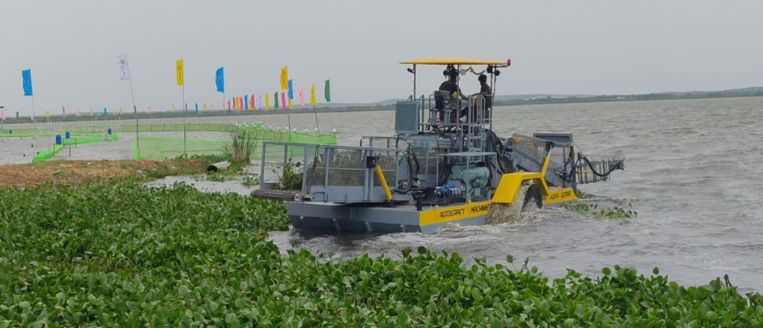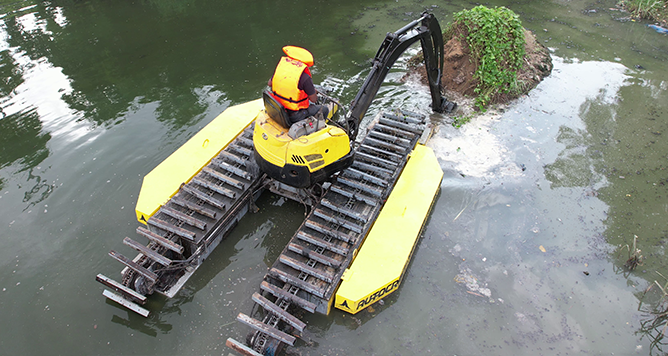
Waterbodies gradually lose capacity due to silt and waste buildup, making desilting, dredging, and the use of an amphibious excavator essential for restoring water flow and reducing flood risk. These issues restrict storage, disturb natural movement, and affect overall waterbody health.
Desilting helps remove accumulated silt and improves depth, while dredging focuses on controlled removal of settled material to maintain proper flow paths and structure. Both processes are critical for lakes, rivers, canals, and wetlands to function effectively.
To carry out these activities in waterlogged and unstable terrain, specialised machines are required. An amphibious excavator is designed to operate directly in such conditions, where conventional land-based equipment cannot work safely or efficiently.
Unlike standard machines, an Amphibious Excavator is built to operate on water and soft ground with stability and control. Its floating design allows it to reach areas that are otherwise inaccessible, making it suitable for complex waterbody restoration work.
In partially submerged zones, the machine also functions as a Floating Excavator, enabling smooth movement and controlled operation without disturbing the surrounding ecosystem or causing structural damage to the waterbody.
Wetlands and marshlands require careful handling to preserve their ecological function. Equipment used in such areas must avoid excessive ground pressure and uncontrolled movement. Machines categorised as Wetland Equipment are designed to work in these sensitive zones without harming natural habitats.
In deeper marshy zones and soft soil conditions, the same machine also performs effectively as a Swamp Excavator, allowing operators to remove accumulated material while maintaining balance and safety throughout the operation.
Urban and rural lakes often suffer from reduced depth due to long-term silt accumulation. Systematic desilting helps restore waterholding capacity and improves overall water quality.
When deployed as a Lake Cleaning Excavator, the machine enables precise removal of silt from lakebeds, supporting long-term waterbody health and reducing the need for repeated manual intervention.
Rivers and canals experience sediment buildup that restricts flow and causes overflow during heavy rainfall. Regular dredging helps maintain channel depth and ensures uninterrupted water movement.
In this role, the machine operates as a Dredging Excavator, supporting planned maintenance activities that improve drainage efficiency and reduce flood-related risks in surrounding areas.
Blocked waterways are a major cause of urban flooding during seasonal rains. Clearing accumulated debris and silt in advance reduces pressure on drainage systems.
Used as an Excavator for Flood, the machine supports preventive maintenance and emergency response by restoring natural water paths and improving discharge capacity in critical zones.
Modern waterbody projects demand precision, stability, and environmental sensitivity. An amphibious excavator combines these qualities, making it suitable for both planned maintenance and restoration work across varied aquatic environments.
The design supports continuous operation in waterlogged areas, allowing operators to complete tasks efficiently without repeated relocation or additional support equipment.
The Rudra Amphimax Amphibious Excavator is engineered specifically for desilting and dredging operations in lakes, rivers, canals, swamps, and wetlands. It is designed to perform reliably in conditions where traditional machines fail, supporting consistent and controlled restoration work.
By addressing real-world site challenges, this machine helps project teams achieve better outcomes while protecting natural water ecosystems.
All our amphibious excavation solutions are designed and manufactured by Autocracy Machinery. We focus on building purpose-built machines that solve real field problems rather than offering generic equipment.
Our approach is based on the belief in using the right machine for the right job, with the flexibility to customise machines according to customer requirements. If you would like to learn more about how amphibious excavation solutions can support your water restoration projects, feel free to reach out for an enquiry.

.jpg)