Plastic waste is drifting along the banks. Water that has lost its clarity, and with that, the fish, plants, and creatures that once lived in it
These are not isolated incidents. They are playing out across hundreds of waterbodies all over the country, and the people responsible for managing them are under real pressure to find solutions that hold up over time, not just for a season or two.
The problem was never a lack of awareness. Most municipal corporations, irrigation departments, and lake development authorities understand what is happening and broadly what needs to be done.The real challenge has always been execution, having the right tools and resources to act consistently and at scale, without draining budgets or exhausting the maintenance crews expected to deliver results.
Manual weed removal has been the standard response for decades. Anyone who has observed it in the field understands where it breaks down
Workers clear one section, move on to the next, and by the time they circle back, the growth has returned, sometimes thicker than before. Water hyacinth is particularly difficult in this regard.When water is warm and nutrient-rich, water hyacinth spreads faster than workers can clear it, turning manual removal into a cycle that never really ends. You are recording the problem, not solving it.
This is not a criticism of the people doing the work. It is a recognition that the method was never designed to handle what these waterbodies are now dealing with. The scale of invasive growth has changed significantly over the years. Community expectations and regulatory standards have risen. In many places, the tools have simply not kept pace.
How an Aquatic Weed Harvester Changes What Is Achievable
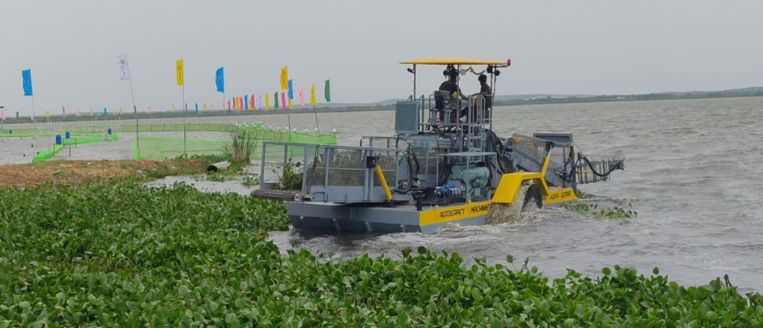
The Rudra Aqua Ultra and Rudra Aqua Max were completely new innovations, not just minor upgrades of previous models. They were designed with a different approach: to maintain waterbodies effectively, equipment must prevent problems, not just fix them after damage occurs.
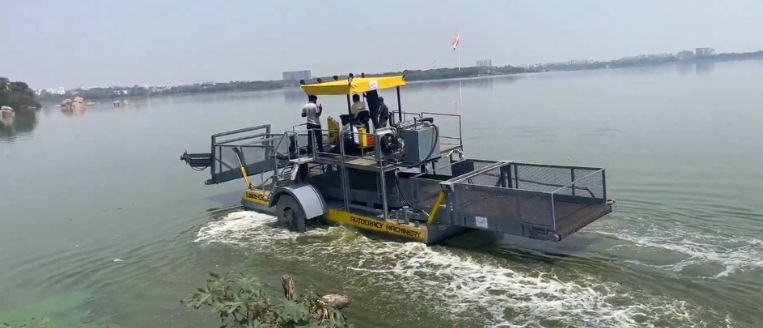
As purpose-built aquatic weed harvesters, the Rudra series uses a precision cutting system that removes invasive plants at the root, not just at the surface where regrowth returns within days. A hydraulic conveyor transfers collected material into onboard storage without interrupting the operation. One continuous pass, no stopping mid-run to offload, and no second crew needed to follow behind and collect what was cut.
What makes it effective as a lake cleaning machine is that it does not treat weeds and floating debris as two separate jobs requiring two separate runs. Plastic waste, organic matter, surface litter, it all comes up in the same operation. Maintenance teams can stop splitting their schedules between garbage collection and weed removal. This lake weed removal machine handles both together, which meaningfully changes what is actually achievable within a given budget and working day.
Weeds are not the only thing accumulating on urban waterbodies. Lakes and canals sit at the low point of the surrounding landscape, which means they collect whatever the city sheds through drainage, stormwater runoff, and wind. Plastic bottles, food packaging, organic waste, construction debris, it arrives constantly and does not slow down between cleaning schedules.
The Rudra series addresses this directly. Operating as a floating trash skimmer during every normal working run, it captures surface debris alongside weed material without requiring a separate operation. The result is a waterbody that is genuinely cleaner after each visit, not just weed-reduced, but visibly clear across the surface in a way that surrounding communities can actually see and appreciate.
A weed blockage in an irrigation canal is not an inconvenience. It limits water flow to fields during critical growth periods, and any delay can directly reduce crop yields. Farmers waiting on water that is not moving cannot absorb that delay. The consequences are specific and real, felt by farming families rather than captured in statistics.
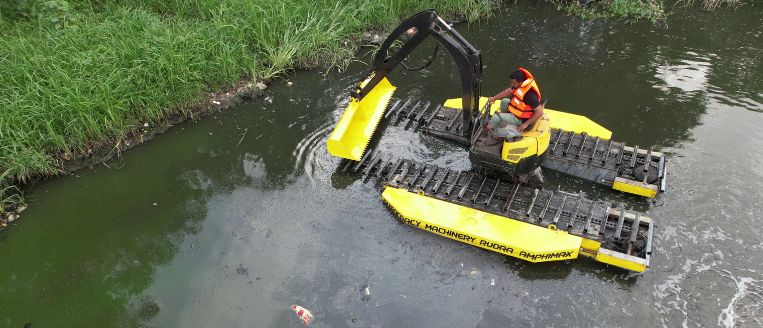
Deployed as a river cleaning machine, the Rudra series handles these environments with the same operational approach it brings to lake maintenance. Continuous operation, simultaneous collection, and onboard storage that allows extended runs without interruption. For irrigation departments responsible for maintaining hundreds of kilometers of canal infrastructure, having equipment with that kind of throughput and reliability is not a preference. It is a practical necessity.
Aquatic Weed Harvester in India: Designed for Ground-Level Realities
Local availability matters in ways that rarely appear in procurement assessments. Spare parts that can be sourced without waiting weeks for an overseas shipment. Service support from teams who have actually worked in the conditions the equipment operates in. The aquatic plant harvester is designed for warmer water temperatures, heavier weed densities, and the operational realities that characterise waterbody management across India.
The Rudra series was built for local conditions from the beginning, instead of adapting old equipment to them
Urban and semi-urban lakes where water quality connects directly to community health, public space value, and civic accountability.
Irrigation canals where weed blockages carry immediate agricultural consequences that cannot wait for the next scheduled maintenance window.
Reservoirs require a level of operational efficiency that manual methods cannot realistically deliver.
River and ecological restoration sites where clearing invasive species is the necessary first step before any meaningful recovery can begin.
Lakes that receive regular, scheduled attention with the right equipment gradually improve. The hyacinth does not get ahead of the maintenance programme. Debris does not accumulate between visits. Fish populations stabilise and recover. The odour that kept people away fades. Communities begin using these spaces again, the way they once did and the way they were always meant to be used.
The Rudra Aqua Ultra and Rudra Aqua Max were built by Autocracy Machinery for organisations ready to make that shift, from managing decline to actually reversing it. As a aquatic weed removal machine, weed harvester machine and a floating garbage collector combined into a single field-tested platform, they give maintenance teams something that has been genuinely lacking: equipment that is equal to the scale of the task.
Clean water is worth protecting. The right tools make that protection achievable, not just as an aspiration, but as something that shows up visibly, season after season, in waterbodies that are genuinely on the mend
.jpg)