Railway infrastructure projects demand accuracy, safety, and minimal disruption to daily operations. A Compact Trenching Machine plays a critical role in such environments where trenching must be completed within narrow corridors and strict maintenance windows. From signalling upgrades to underground utility routing, excavation work has to be carried out with precision while protecting nearby railway assets.
Railway trenching activities must be planned carefully to avoid damage to existing tracks, sleepers, cables, and drainage systems. Most works are executed near active lines, inside yards, or within station premises where space is limited and safety rules are strict. Clean trench formation and controlled soil removal are essential to maintaining operational continuity.
As railway networks continue to expand and modernise, the need for predictable and well-managed trenching has increased. Engineers and contractors now rely on machines that can operate safely in confined railway zones while meeting operational standards and tight project timelines. This shift has made controlled trenching solutions an important part of railway maintenance and infrastructure development.
Railway sites are different from open construction zones. Access is restricted, working widths are narrow, and the ground conditions change frequently due to ballast, compacted soil, and service crossings. Manual trenching is slow and risky, while large excavators are often unsuitable for confined rail environments.
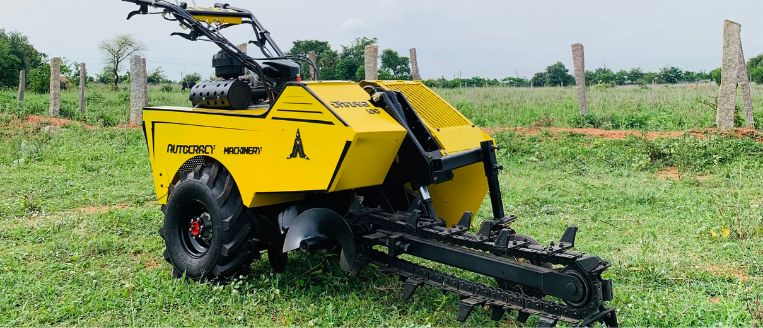
This is where a Walk Behind Trencher fits naturally into railway maintenance and upgrade work. It allows crews to cut precise trenches along cable routes and service paths while maintaining full control over depth and alignment, reducing the chance of damage to critical railway assets.
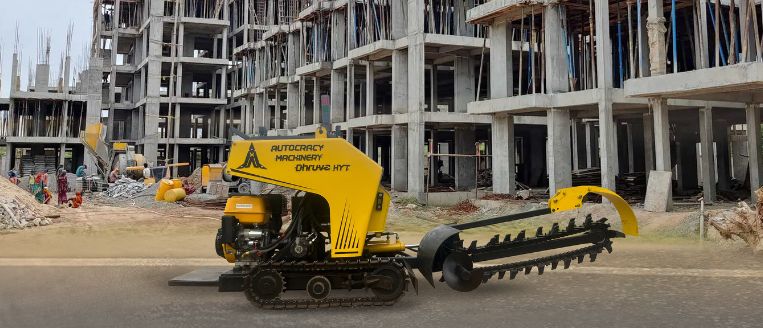
The Dhruva HYT is designed as a Self Propelled Machine that supports controlled trenching in areas where mobility and balance matter more than raw size. Its independent movement allows operators to work along platforms, service roads, and trackside corridors without relying on towing vehicles or additional equipment.
For railway contractors, this independence simplifies logistics during night blocks and short maintenance windows. The machine can be moved quickly between work zones, reducing setup time and helping teams complete trenching tasks within tight operational schedules.
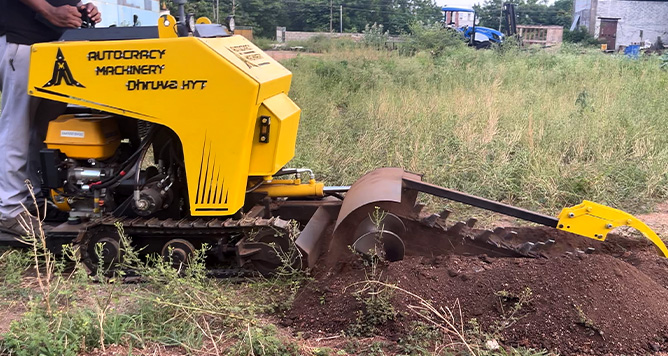
Railway authorities place strong emphasis on safe excavation near live infrastructure. A compact trencher enables gradual soil removal, ensuring that trench walls remain stable and the surrounding ground is not disturbed. This controlled process reduces the risk of ballast collapse or settlement near tracks.
Such machines also help maintain clean work sites. Spoil is managed efficiently, keeping platforms and walkways clear, which is critical in stations and depots where passenger movement or rolling stock operations continue alongside maintenance work.
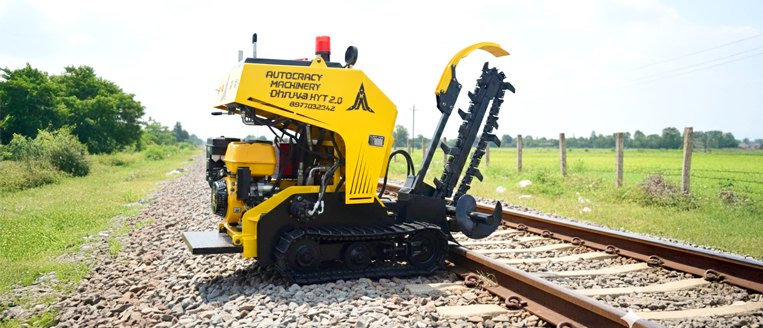
Railway trenching often involves working parallel to tracks, between signal cabins, or inside yards with limited turning space. A track trencher provides stable movement over uneven surfaces such as compacted soil, ballast edges, and service paths without slipping or losing alignment.
This stability is especially useful during signalling and communication upgrades where trenches must follow predefined routes. Smooth and predictable movement ensures consistent trench profiles, making cable laying and duct placement faster and more reliable.
Modern rail systems depend on underground services for signalling, communication, and power distribution. A portable trenching machine allows teams to open narrow trenches for these services without extensive site preparation or heavy lifting equipment.
It is commonly used as a utility duct trencher during the installation of signal cables, data lines, and drainage routes within station limits and along trackside boundaries. This approach reduces dependency on manual labour and improves consistency across long cable runs.
Metro and suburban rail projects often pass through densely populated areas. An urban trencher India solution helps contractors work within city limits where space constraints, safety regulations, and time pressures are high. The ability to trench neatly and restore surfaces quickly is a major advantage in such projects.
This capability supports ongoing maintenance as well as new installations, ensuring that railway authorities can upgrade systems without extended service disruptions or repeated excavation work.
For contractors working on rail projects, a fuel-efficient trencher reduces operational costs while delivering steady output across long maintenance shifts. Lower fuel use also supports cleaner work practices, which is increasingly important in public infrastructure projects.
Engineers benefit from predictable trench dimensions and controlled excavation, which simplifies planning and inspection. Together, these advantages help improve project timelines, safety compliance, and overall execution quality in railway trenching work.
Autocracy Machinery designs and manufactures specialised trenching solutions that support railway infrastructure development, enabling contractors and authorities to select reliable machines suited to complex and space-restricted environments.