Infrastructure development operates under strict timelines. Every hour of delay accumulates, whether you're laying out a solar farm, expanding a telecom network, or rolling out streetlights across a city corridor. The challenge has always been the same: pole erection is slow, labour-heavy, and carries real safety risks when done the conventional way. Contractors relying on makeshift pole-lifting machines or manual crews know the drill: it is inefficient, unpredictable, and expensive. That's the gap the Mayura P was built to fill.
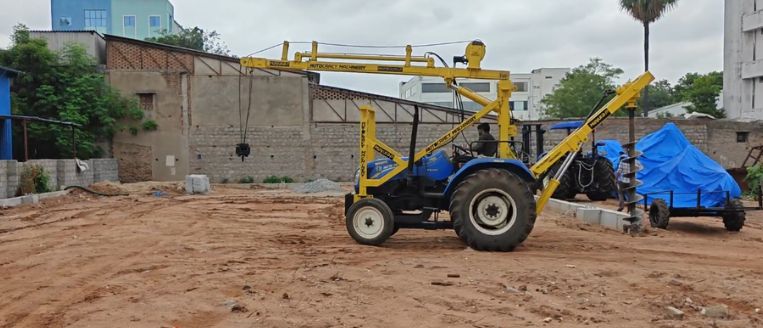
Mounted directly onto a tractor, the Mayura P is a purpose-built pole erection machine designed with field realities in mind, not just engineering specs. It does two things exceptionally well: digs deep holes and erects poles, all from a single unit. That alone changes how a job site runs.
Most contractors involved in pole installation rely on separate equipment for digging and lifting, using augers to prepare the ground and cranes or manual labour to erect the poles. The Mayura P handles both. It digs down to 2000 mm and can erect poles up to 24 feet tall, carrying loads of up to 1 metric ton.
The hydraulically controlled system gives operators the precision to position poles accurately the first time, without the back-and-forth of manual adjustments. On large sites, such as solar parks and telecom rollouts, that kind of consistency across hundreds of pole erections makes a material difference to the overall project timeline.
The machine's auger drive is central to its capability. With interchangeable auger heads ranging from 150 mm to 450 mm, it handles a variety of soil conditions without requiring additional equipment or site prep. Whether it's loose sandy terrain or harder ground, the right head gets the job done.
The hydraulic boom and telescopic system, assisted by a worm-winch mechanism, give operators confident control during pole erection, with no improvised rigging and no guesswork. Unlike conventional pole lifting machines that depend heavily on operator experience and crew coordination, the Mayura P keeps the process controlled and repeatable. The frame and components are built for repeated daily use in field conditions, not occasional light-duty work.
Because it runs off the tractor's PTO, the Mayura P integrates directly into equipment fleets that contractors already operate. There's no need to bring in additional pole erection equipment or machinery, which simplifies logistics and reduces costs on-site.
The Mayura P finds its footing across a wide range of industries:
Installing poles for power transmission lines, solar support structures, and related infrastructure goes faster without separate lifting crews or crane rental. As a dedicated pole erection machine, it keeps solar farm timelines on track.
Whether it's micro towers, signal boosters, or communication line poles, stable and accurate pole erection is critical. The machine delivers that repeatability at scale, replacing the need for heavy crane-based pole erection equipment on most standard installations.
LED streetlights, CCTV mounts, road lighting infrastructure, and urban projects with tight timelines benefit from the reduced footprint and faster cycle times that the Mayura P offers as a compact pole lifting machine suited to busy environments.
Electric fencing for large agricultural properties, radar poles, and surveillance mounts, the machine handles these with the same reliability it brings to larger infrastructure pole erection work.
Pole erection, done the traditional way, comes with real exposure, with workers handling heavy loads manually, crane operations in constrained or high-traffic environments, and the coordination overhead that comes with it. The Mayura P's hydraulic controls and stable telescopic operation reduce that exposure significantly. As a self-contained pole erection machine, it removes much of the unpredictability that comes with operating separate pole erection equipment across a large site.
Beyond safety, the reduction in manpower requirements is straightforward. Fewer people needed per pole erection cycle means lower labour costs per unit, and more installations completed per day. For contractors working against project milestones or fixed-price contracts, that efficiency translates directly into margin.
Infrastructure demands are growing, with smart city rollouts, rural electrification, and renewable energy expansion. The projects getting funded today are larger and more time-sensitive than ever. Equipment that can keep pace with those demands, without compromising safety or quality, is what separates contractors who scale from those who stall.
The Mayura P doesn't try to do everything. It specialises in one category of work, pole erection, and does it exceptionally well, replacing a combination of manual labour, cranes, and fragmented pole erection equipment with a single, controllable machine. As both a pole lifting machine and an auger-based excavator, it compresses what used to take multiple resources into one streamlined operation.
For contractors, utility providers, municipalities, and government agencies with ongoing pole erection needs, that's not just a productivity gain. It's a fundamentally different way of approaching the work entirely.
.jpg)