Urban waterbodies such as lakes, ponds, canals, and rivers rely on efficient lake cleaning equipments to support environmental sustainability, flood control, and community well-being in growing cities. To safeguard these ecosystems, municipal bodies increasingly depend on mechanised solutions that can address modern urban maintenance requirements.
Effective waterbody cleaning and maintenance require planned intervention, modern tools, and sustainable methods. From aquatic weed overgrowth to floating waste accumulation and siltation, the sector demands solutions that are efficient, scalable, and environmentally responsible.
Waterbody maintenance projects demand equipment that can operate efficiently in aquatic and semi-aquatic environments without disturbing natural ecosystems. Machines must be capable of handling floating vegetation, surface waste, and submerged debris while ensuring safe operation in shallow and deep-water conditions.
Another critical requirement is versatility. Urban waterbodies vary widely in size, depth, and contamination levels. Authorities increasingly rely on specialised lake cleaning equipments that can adapt to different site conditions while delivering consistent performance with minimal manual intervention.
One of the biggest challenges is the excessive growth of invasive aquatic weeds and vegetation, which obstructs water flow and reduces oxygen levels. Manual cleaning methods are labour-intensive, slow, and often ineffective for large waterbodies, leading to recurring maintenance issues.
Floating plastic waste, debris, and silt accumulation further complicate maintenance efforts. Traditional land-based machines struggle to operate in waterlogged or marshy areas, increasing dependency on inefficient processes. These challenges highlight the urgent need for modern, purpose-built lake cleaning equipments that can support long-term sustainability goals.
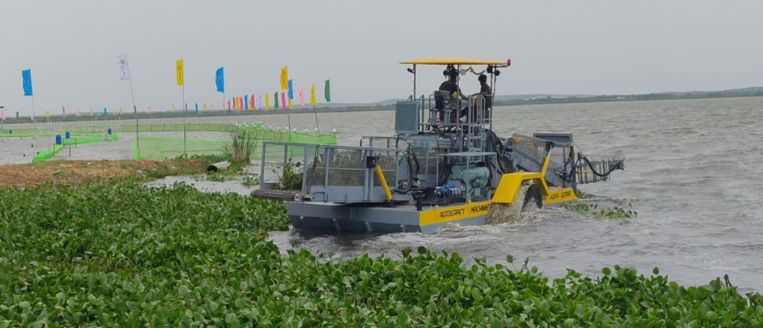
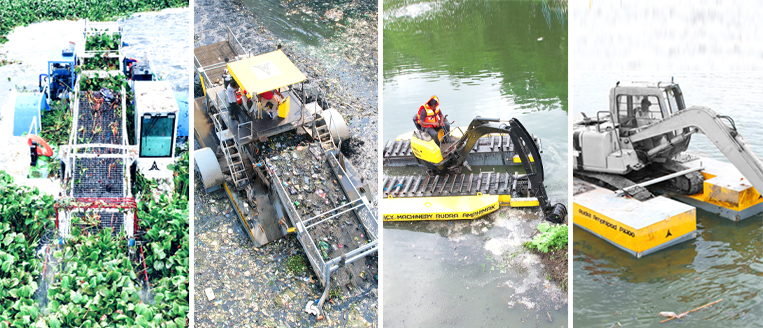
The Aquatic Weed Harvester Rudra Aqua Ultra is designed specifically to tackle dense aquatic vegetation in lakes, canals, rivers, and ponds. It enables systematic aquatic vegetation removal, helping restore natural water flow and improve water quality. This machine replaces labour-heavy methods with a controlled and efficient cleaning process.
As a reliable lake cleaning machine, it supports sustainable waterbody restoration by collecting weeds, algae, and surface debris while maintaining ecological balance. Its operation helps prevent stagnation and supports long-term waterbody health.
Key Features
Purpose-built for large-scale aquatic weed harvesting
Stable platform for safe operation in shallow and weed-dense waters
Integrated cutting and collection system for continuous cleaning
Designed to minimise disturbance to aquatic ecosystems
Use Cases
Lake and pond rejuvenation projects
Canal and irrigation channel maintenance
Aquaculture waterbody cleaning
Urban waterbody restoration initiatives
The Floating Trash Removal Rudra Aqua Max is designed to address floating waste challenges in urban waterbodies. It efficiently supports floating trash removal, helping clear plastics, debris, and surface vegetation from lakes, rivers, and canals.
As an advanced aquatic cleaning machine, it plays a critical role in maintaining cleaner waterways, reducing pollution, and preventing blockages. It is also effective for lake debris removal and functions reliably as a river debris collector in flowing water conditions.
Key Features
High-capacity floating waste collection system
Stable design for operation in calm and flowing waters
Corrosion-resistant structure for polluted environments
Operator-friendly controls for extended cleaning operations
Use Cases
Urban lake and river surface cleaning
Removal of floating plastic waste and debris
Canal and drainage cleaning before monsoons
Environmental restoration and CSR projects
The Amphibious Excavator Rudra Amphimax is engineered for challenging wetland and waterlogged environments where conventional machines cannot operate. It functions efficiently as a Floating Excavator for dredging, desilting, and restoration activities.
Often used as a Lake Cleaning Excavator, Dredging Excavator, and Swamp Excavator, this machine enables controlled removal of silt, sludge, and vegetation while operating safely on soft and submerged terrain.
Key Features
Amphibious design for waterlogged and marshy areas
Stable operation with minimal ground pressure
Compatible with multiple excavation and dredging tools
Designed for eco-sensitive aquatic environments
Use Cases
Lake and river desilting operations
Wetland and marshland restoration
Canal cleaning and flood mitigation
Sludge and silt removal in water reservoirs
The Floating Pontoon Excavator Rudra Amphipod PX100 provides a stable and adaptable platform for excavation work on water. Designed for dredging and aquatic vegetation removal, it supports a wide range of waterbody maintenance activities.
As a dependable pontoon excavator, it allows excavators to operate safely on floating platforms. The Floating Pontoon system ensures stability, making it ideal for prolonged restoration and rehabilitation projects in lakes, canals, and rivers.
Key Features
Robust floating pontoon platform for excavator mounting
Modular design for easy transport and assembly
Stable operation in fluctuating water levels
Designed for long-duration aquatic projects
Use Cases
Canal and river dredging projects
Aquatic vegetation removal and cleanup
Pond and lake rehabilitation works
Flood control and waterway maintenance
All these machines are manufactured by Autocracy Machinery, with a clear focus on solving real-world challenges in environmental sustainability and waterbody maintenance. We design and build purpose-built machines that support efficient cleaning, restoration, and long-term management of aquatic ecosystems.
If you would like to learn more about selecting the right solutions for your waterbody cleaning requirements or explore how these machines can support your projects, feel free to reach out for an enquiry or further discussion.

.jpg)