Across many industries, underground installation work has become an important part of infrastructure development. A trench digger machine is increasingly used to create clean and uniform trenches for irrigation pipelines, telecom cables, electrical lines, and drainage systems. Traditional digging methods using manual labour or large excavators often take more time and disturb the surrounding soil.
These machines are designed to produce narrow and consistent trenches with better speed and precision. As a result, they help contractors and project teams complete trenching work efficiently, making them suitable for both rural and semi-urban infrastructure projects.
In many regions, digging trenches manually is still common. While manual digging may work for very small tasks, it becomes inefficient when long pipeline or cable routes need to be completed within tight project timelines.
Excavators are sometimes used as an alternative, but they remove large volumes of soil and create wide trenches that require additional backfilling work. This leads to higher labour requirements and longer restoration time. Projects that require accurate trench depth and minimal soil disturbance, therefore, need a more specialised solution.
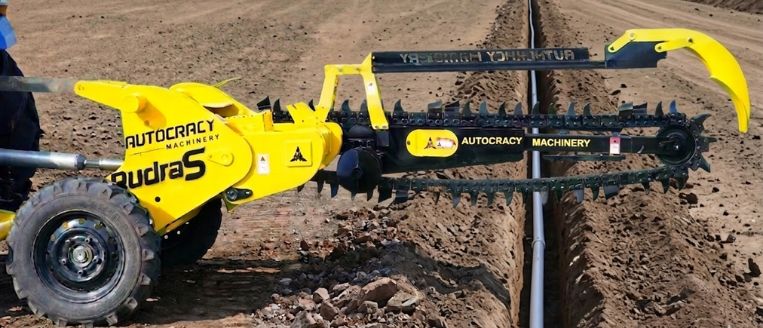
A dedicated trench digger machine is designed specifically to solve these problems. Instead of removing excessive soil, the machine cuts through the ground in a controlled manner, producing uniform trenches with consistent depth and width.
This method improves the quality of underground installations while reducing the time required for excavation. It also allows contractors to work efficiently across long project stretches without repeatedly stopping for soil removal or trench correction.
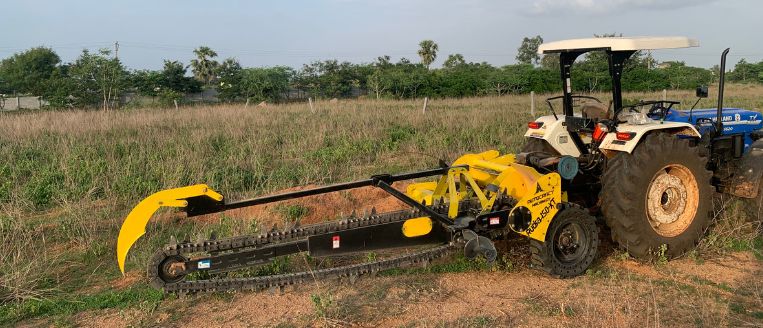
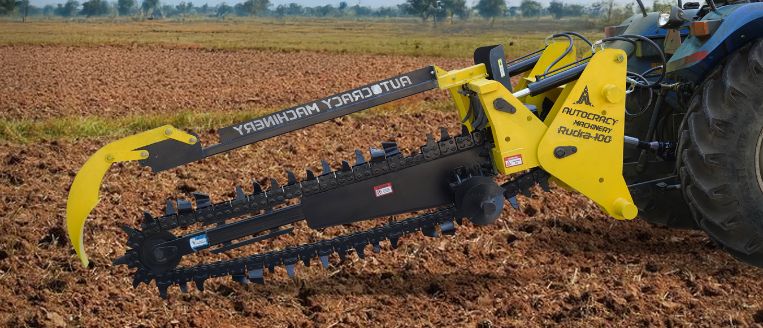
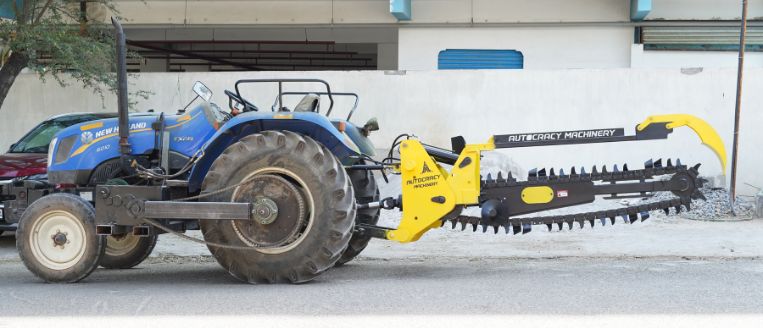
One example of such equipment is the Rudra 100, a tractor-mounted trencher machine developed for rural and infrastructure projects. Designed to work with tractors between 50–120 HP, this machine offers a practical solution for trenching across farms, village roads, and utility corridors.
The Rudra 100 supports trench depths of up to 1200 mm and trench widths between 150–280 mm, making it suitable for various underground installations. With a trenching speed of 40–150 metres per hour and fuel consumption of only 3–5 litres per hour, it helps contractors complete projects efficiently while keeping operational costs low.
A chain trencher mechanism allows the machine to cut through soil using a rotating chain equipped with cutting teeth. This design helps maintain stable trench profiles even when working across different soil types such as clay, sandy loam, or black cotton soil.
The machine’s balanced structure and tractor-mounted system provide good traction and stability during operation. As a result, trenching work can continue smoothly even in agricultural fields or semi-urban terrains where soil conditions change frequently.
The versatility of a trench digger machine allows it to support several industries that rely on underground installations.
In agriculture, trenching is required for irrigation pipelines, drip irrigation systems, and farm drainage lines. The machine enables farmers and contractors to prepare fields efficiently without disturbing large areas of farmland.
Rural water supply schemes and village pipeline networks require long trenches for water distribution systems. A single chain trencher helps maintain uniform trench depth for safe pipeline installation.
Telecom companies install underground ducts for fibre optic cable networks. A reliable trenching machine allows contractors to dig narrow trenches quickly across villages, roadsides, and rural pathways.
Electrical cable installations and rural electrification projects also require consistent trenching work. The machine helps maintain accurate trench alignment for underground utility networks.
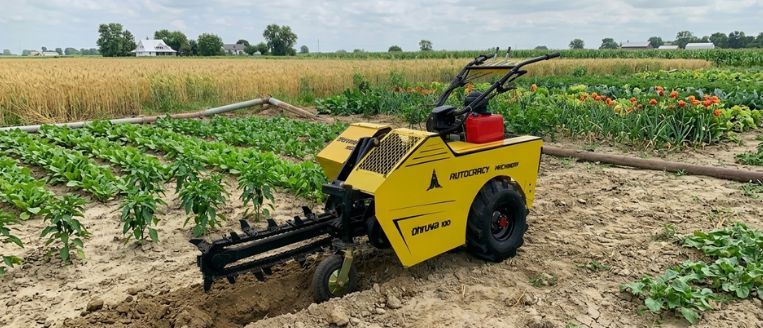
Contractors working on drainage systems, road utilities, and underground communication lines often prefer a compact trencher because it can operate easily in restricted areas where larger machines may not be suitable.
Solar farms and renewable energy installations also require trenching for underground cable routing. A compact trenching machine ensures fast installation while maintaining site efficiency.
The Rudra 100 is designed to deliver high productivity while keeping operating costs manageable. With trenching output reaching up to 900–1200 metres per day, it significantly reduces project completion time compared to manual digging.
Because the machine is tractor-mounted, it can easily move between different project locations without requiring special transportation equipment. This mobility is particularly useful in rural infrastructure projects where access to heavy transport vehicles may be limited.
Another advantage is fuel efficiency. Consuming only a small amount of fuel per hour, the machine helps contractors manage long-duration trenching operations without excessive operational expenses.
By using specialised equipment instead of manual digging, contractors can achieve better trench quality and reduce the need for rework. Uniform trenches improve the safety and durability of underground installations, ensuring pipelines, cables, and drainage systems remain properly aligned.
The compact design of the Rudra 100 also helps operators work in narrow pathways, agricultural fields, and village roads where space is limited. This flexibility makes it a reliable option for projects that require precision and mobility.
Infrastructure development across agriculture, utilities, telecom, and construction sectors increasingly depends on efficient trenching solutions. A modern trench digger machine like the Rudra 100 helps deliver the accuracy, speed, and cost efficiency required for such projects.
At Autocracy Machinery, we design and manufacture purpose-built equipment to solve real-world infrastructure challenges. Machines like the Rudra 100 help contractors and project teams complete trenching work faster while maintaining consistent quality across diverse project environments.
If you are exploring reliable trenching solutions for your upcoming projects, our team would be happy to guide you further.